


An AI business case for accounting firms usually arrives as a vendor’s percentage on a slide. The leadership of an accounting and payroll outsourcing firm had already seen how that ends: a previous software rollout that staff simply did not use. Before any talk of tools, they needed a way to see whether automation would pay off in her firm, in her numbers. We built a working capacity and margin model that does exactly that: every input editable, every step of the logic visible.
The problem: “hours saved” is not a business case
Accounting firms spend a large share of their time on routine work: keying in invoices and receipts, answering routine client questions, and running month-end checklists and reports. Everyone agrees some of it can be automated. The decision still stalls, for three reasons:
- Vendor numbers are not the firm’s numbers. A percentage from someone else’s case study says nothing about this team.
- Freed hours do not become money on their own. They become capacity, and capacity is only valuable if the firm decides what to do with it.
- Adoption is the real risk. The firm had lived through software that looked good and then went unused. A business case had to be something the team could check and own.
What we built
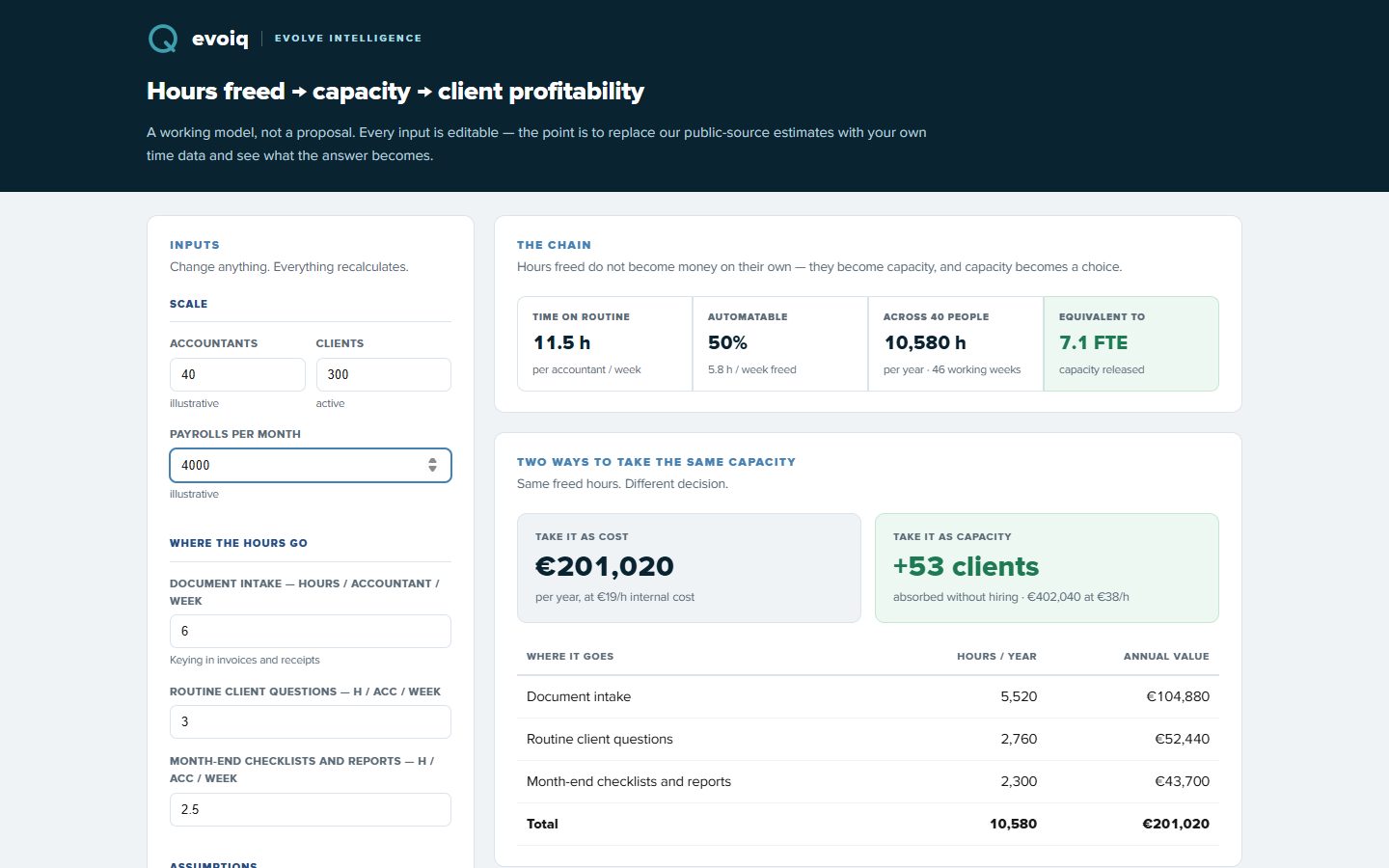
A single-page model that follows the chain from time to money:
- Scale. Number of accountants, active clients and payrolls per month.
- Where the hours go. Hours per accountant per week on document intake, routine client questions, and month-end checklists and reports.
- Assumptions, stated openly. The share of that time that can be automated (set deliberately conservative), internal cost per hour, billing rate and billable hours per year.
- The chain. Time on routine work, the automatable share, hours freed per year across the team, and the equivalent in full-time roles.
- Two ways to take the same capacity. Take it as cost (the value of the hours at internal cost), or take it as capacity (how many additional clients the same team could serve without hiring, at the billing rate). A table breaks the value down by type of work.
The model also puts the timing in context. In the firm’s market, structured e-invoicing becomes mandatory for business-to-business invoices on 1 January 2028. Machine-readable invoices remove the main technical obstacle to automating document intake, and moving hundreds of clients onto e-invoicing is itself a service the firm can sell.
What changes for the decision
| Before | With the capacity model | |
|---|---|---|
| Starting point | A vendor’s percentage | The firm’s own hours, rates and clients |
| Logic | Hidden in a slide | Every step visible and editable |
| What the hours become | “Savings” | A choice: lower cost or more clients per accountant |
| Timing | “Sometime” | Tied to the e-invoicing deadline |
| Next step | Buy a tool | Baseline one workflow, then measure it again |
The number that matters is not on the page. The firm already had years of time-tracking data, enough to baseline one workflow precisely and measure the same workflow after automation. That turns the model from a vendor’s estimate into the firm’s own evidence.
Where people stay in control
The model makes no promises. Its defaults are placeholders taken from public information and conservative assumptions, clearly marked as such, and they exist to be replaced. The firm decides which workflow to measure first, what share is realistic, and whether freed hours go to cost or growth.
Where else this works
The same capacity logic fits any professional services firm that sells hours:
- Payroll and HR outsourcing: payslips, queries and month-end reporting per specialist.
- Law firms: document review and routine correspondence per associate.
- Engineering and estimating teams: document reading before the first price, turned into more bids per estimator.
Related use cases: AI meeting minutes and project status · EU AI Act for banks · Supplier invoice reconciliation. All Internal assistants & tools use cases · How we deliver this: AI strategy & consulting
FAQ
How do you calculate ROI for AI in an accounting firm?
Start with hours per accountant on routine work, apply a conservative automatable share, and convert freed hours into either cost at the internal rate or extra clients at the billing rate.
Why not just use the savings a vendor quotes?
Because they come from someone else’s firm. A model built on your own hours and rates, and then checked against one measured workflow, is evidence your team can trust.
How does e-invoicing affect automation?
Structured e-invoices are machine-readable, which removes the hardest part of automating document intake. A mandatory deadline also sets a natural timeline for the project.
Want to see what automation is worth in your own numbers? Talk to us