


Insurance product documentation AI changes where a new product starts. For the product and development team of a life insurer, a new rider meant writing three documents from scratch: the policy rules, the key information document (KID) summary and the plain-language text for the website all had to be drafted separately and then checked against the existing rulebook. We built an assistant that takes a one-paragraph product description and returns all three documents as a first draft, aligned with the insurer’s existing rules and house style.
The problem: three documents, one product, many cross-references
A life insurer does not launch products in isolation. A new supplementary cover, for example outpatient cancer treatment or a children’s injury cover, sits on top of a main policy. Its rules have to reuse the definitions already set in the main rules, respect waiting periods and age limits, and point to the right clauses rather than inventing new terms.
For the product team this meant:
- Three documents written by hand. The policy rules (ten fixed chapters, decimal-numbered clauses), the regulated KID summary with its mandatory headings, and a customer-friendly text with frequently asked questions.
- Constant cross-checking. Every definition, exclusion and extreme-sports list already defined in the main rules had to be found and referenced, not rewritten.
- House style by memory. Legal numbering, capitalised defined terms and numbers written out in words (“90 (ninety) calendar days”) were checked line by line.
- Late questions. Missing parameters such as the waiting period, the sum insured or how the benefit is calculated often surfaced only after the first draft was already circulating.
What we built
A drafting assistant that works in three steps, in the team’s own language:
- The product manager describes the new cover in free text. One paragraph is enough: who is insured, age range, sum insured, how the benefit is paid, the waiting period. The manager also picks which existing policy the cover attaches to and which edition of the rules applies.
- The assistant asks what is missing. Within about ten seconds it returns three to five short questions that must be answered before the rules can be written correctly: waiting period, age limits, benefit calculation, exclusions, interaction with existing covers. The manager answers or skips.
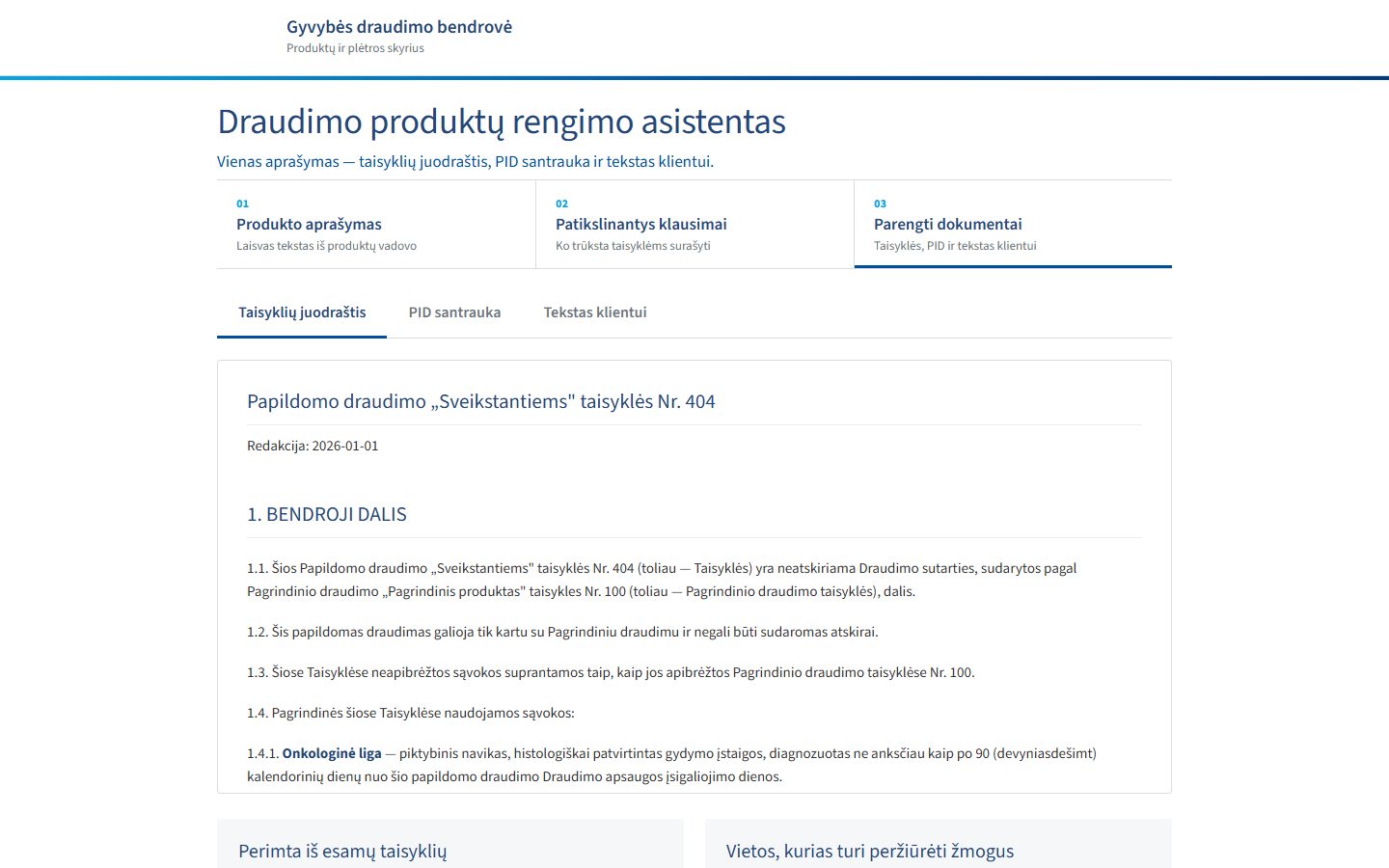
- It drafts the three documents together. The rules follow the insurer’s ten-chapter structure and house style, the KID summary uses the regulated headings, and the customer text is written in short sentences with five FAQs. Text starts appearing within seconds and the full set is ready in about two minutes.
Under the drafts, two panels do the checking work: what was taken over from existing rules, with the exact rule and clause each definition came from, and places a person must review: possible conflicts with existing rules, cross-references, ambiguities and figures that need an actuary.
The assistant was built on the insurer’s publicly available policy rules and KID documents. No internal data was needed to reach a useful first draft.
What changes for the team
| Before | With the drafting assistant | |
|---|---|---|
| Starting point | Blank page for each of three documents | One product description |
| Missing parameters | Found during review rounds | Asked for before drafting starts |
| Consistency with main rules | Checked by searching the rulebook | Reused clauses listed with their references |
| House style | Applied by hand | Built into every draft |
| First complete draft set | Written document by document | Rules, KID summary and customer text in about two minutes |
The team still owns the wording. What changes is that the first review meeting discusses the product, not missing definitions and numbering.
Where people stay in control
Everything the assistant produces is a draft for review, not a final edition. It does not decide premiums, underwriting or pricing: those are actuarial decisions and, in life and health insurance, a high-risk area under the EU AI Act. We deliberately kept the assistant on documentation, which sits outside that line.
Each draft shows where it came from and where a human must look. The “review” panel is not a list of errors; it points to the places where judgement is needed, such as a figure that needs actuarial sign-off or a clause that could conflict with an existing cover.
Where else this works
The same pattern fits any team that writes regulated documents from a structured idea:
- Banks and lenders: product terms and pre-contractual information for a new loan or deposit.
- Manufacturers: technical data sheets and declarations of performance from one product specification.
- Public bodies: procurement conditions drafted from a short needs description.
Related use cases: Insurance policy document extraction · Competitor policy monitoring · Product catalogue AI assistant. All Internal assistants & tools use cases · How we deliver this: AI applications
FAQ
Does the AI write final policy wording?
No. It produces a complete first draft of the rules, KID summary and customer text. The product team reviews, edits and approves every document.
How does it stay consistent with existing policy rules?
It is given the insurer’s existing rules and house style. It reuses defined terms instead of inventing new ones and lists every clause it took over, with the rule and clause number.
Does it touch underwriting or pricing?
No. Risk assessment and pricing in life and health insurance are high-risk under the EU AI Act, so the assistant is limited to documentation and leaves all actuarial figures for a person to set.
Planning a new product line and want the first drafts to write themselves? Talk to us