


AI meeting minutes and project status reports usually fail for the same reason: they summarise what was said and miss what was not. For the project management office (PMO) of a supervised bank, the weekly routine after every steering committee was the same: write the minutes, update the portfolio status for management, and refresh the risk register. We built an assistant that turns one meeting transcript or a page of rough notes into all three documents, and checks what was said against the whole project portfolio.
The problem: the important part is between projects
A bank’s change portfolio runs several projects at once: a card launch, regulatory changes to consumer lending, DORA work on ICT supplier contracts, deposit products, reporting migrations. Each has its own committee, and each committee talks only about its own project.
That creates three recurring problems for the PMO:
- Write-up after every meeting. Minutes, action lists, a status line per project and new risks are written by hand after every meeting.
- Decisions that are not decisions. “Let’s leave it open and come back next week” is often recorded as agreed. Actions without an owner disappear.
- Conflicts nobody mentions. An engineer commits to testing on one project in September, while the portfolio already has the same person booked on another project in the same weeks. Nobody in the room sees both plans at once.
What we built
A PMO assistant that works from whatever the meeting produced:
- Input: the transcript or the notes. A Teams transcript with timestamps, rough handwritten notes, or a short weekly sync covering several projects all work.
- Clarifying questions. Within about ten seconds the assistant asks three to five questions about what is genuinely unclear: unconfirmed dates, missing owners, conditional decisions. The PMO lead answers or skips.
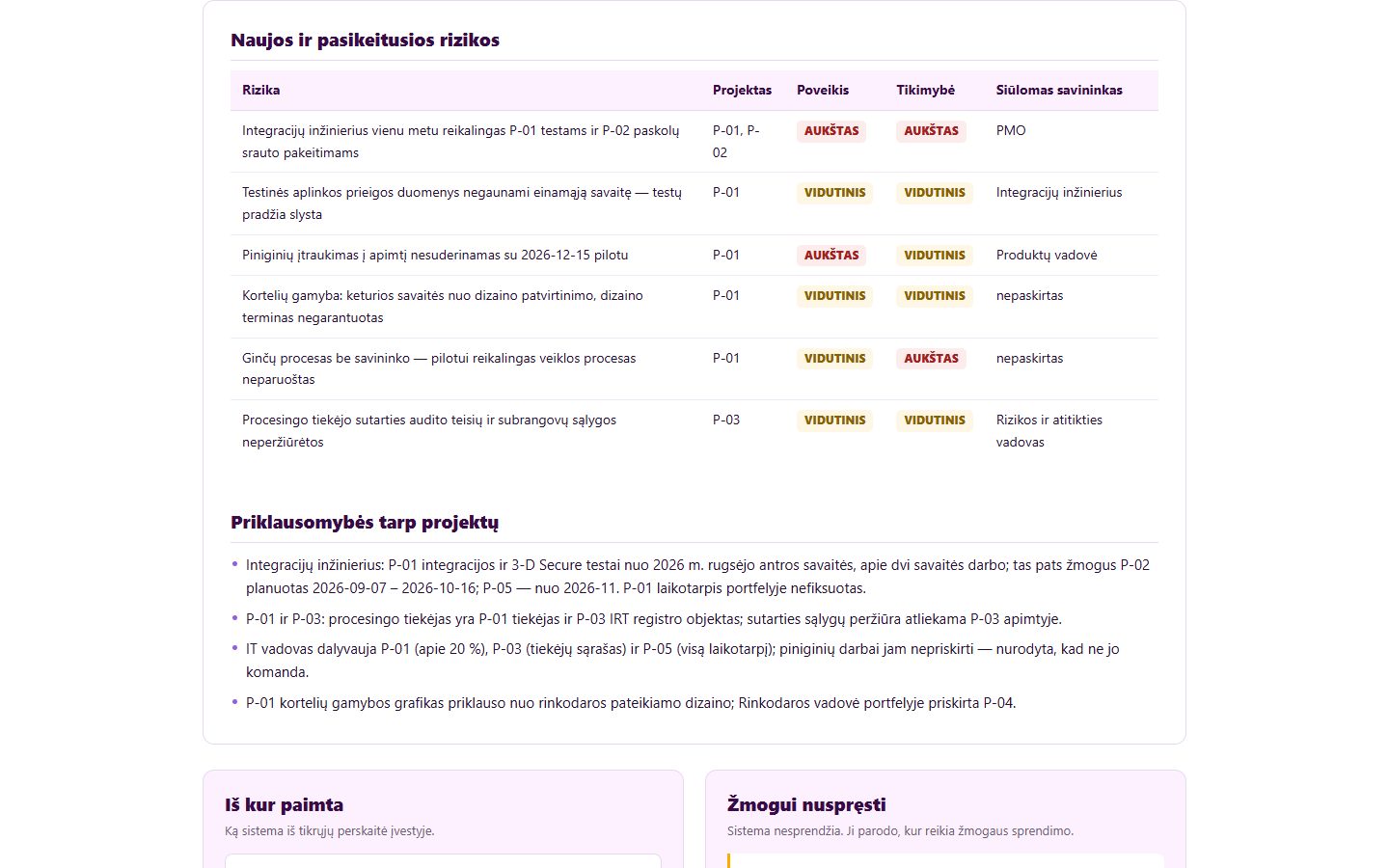
- Three documents at once. Minutes with decisions, open items and an action table; a portfolio status for management with a red/amber/green line per project; and a risk and dependency register. The full set is ready in about 50 to 60 seconds.
Before writing, the assistant runs five fixed checks against the portfolio: date and resource clashes between projects, the type of each deadline (external and regulatory, or internal and movable), actions without an owner, conditional “decisions” that are not decisions, and questions raised and then dropped.
Two panels sit under the documents: where each point came from, quoting the transcript line and timestamp, and for a person to decide, which lists the choices only management can make.
What changes for the PMO
| Before | With the PMO assistant | |
|---|---|---|
| Minutes, status and risks | Written separately after each meeting | Drafted together from one input |
| Cross-project clashes | Spotted if someone remembers both plans | Checked against the whole portfolio every time |
| Regulatory vs internal deadlines | Known to the PMO, rarely stated | Stated when deadlines collide: which one can move |
| Open items | “To be discussed” | Listed with a missing owner flagged |
| Traceability | Depends on the note-taker | Every point quoted with its timestamp |
In testing, the resource clash between two projects was not planted in the input. It surfaced only by comparing the meeting with the portfolio, and it came up first in the decision panel in every run.
Where people stay in control
The assistant does not decide which project slips. When a regulatory deadline collides with an internal launch date, it states the fact: the regulatory date cannot move, the internal one can. The choice stays with management.
It works on internal project administration only, with no customer data and no customer decisions. That keeps it in the minimal-risk zone of the EU AI Act, which is why a supervised bank can start here long before touching regulated processes.
Where else this works
The pattern suits any organisation running several projects with shared people:
- Construction and engineering: site meetings turned into minutes, look-ahead status and a risk log across projects.
- Manufacturing: weekly production and engineering change meetings checked against capacity plans.
- IT and consulting firms: client steering committees with consultants shared between accounts.
Related use cases: AI candidate matching · AI business case for accounting firms · EU AI Act for banks. All Internal assistants & tools use cases · How we deliver this: AI applications
FAQ
Does it work without meeting transcripts?
Yes. Rough handwritten notes work as well as a Teams transcript. The assistant asks about what the notes leave unclear before writing.
How does it find conflicts that were not discussed?
It compares every date and person mentioned in the meeting with the portfolio plan, so a clash with another project appears even if nobody in the room raised it.
Can a bank use this under the EU AI Act and DORA?
Internal project administration with no customer decisions is minimal risk under the EU AI Act. The AI provider still has to be assessed as an ICT third party under DORA before any real data is used.
Want your next steering committee to end with the minutes already written? Talk to us