


Competitor policy monitoring used to mean an analyst opening a competitor’s new terms and conditions and hunting for the one line that changed. For a life insurer’s product team we built a radar that follows competitors’ public terms, notices when a new edition appears, compares it with the previous one clause by clause, and explains each meaningful change in plain language, with the clause number and a link to the source.
The problem: the change is one line in a long document
Insurers publish their terms, and they publish new editions of them. A product team wants to know when a competitor tightens a claims deadline, widens an exclusion or changes a definition, because those are the places where products actually compete.
Finding it by hand is slow and unreliable. Editions are published as PDFs of different lengths, clauses are renumbered, and each company structures its documents differently: some number every clause, some write continuous text. A simple word search does not help either. In one real case, the phrase that carried the change appeared the same number of times in both editions; what changed was the clause it appeared in.
What we built
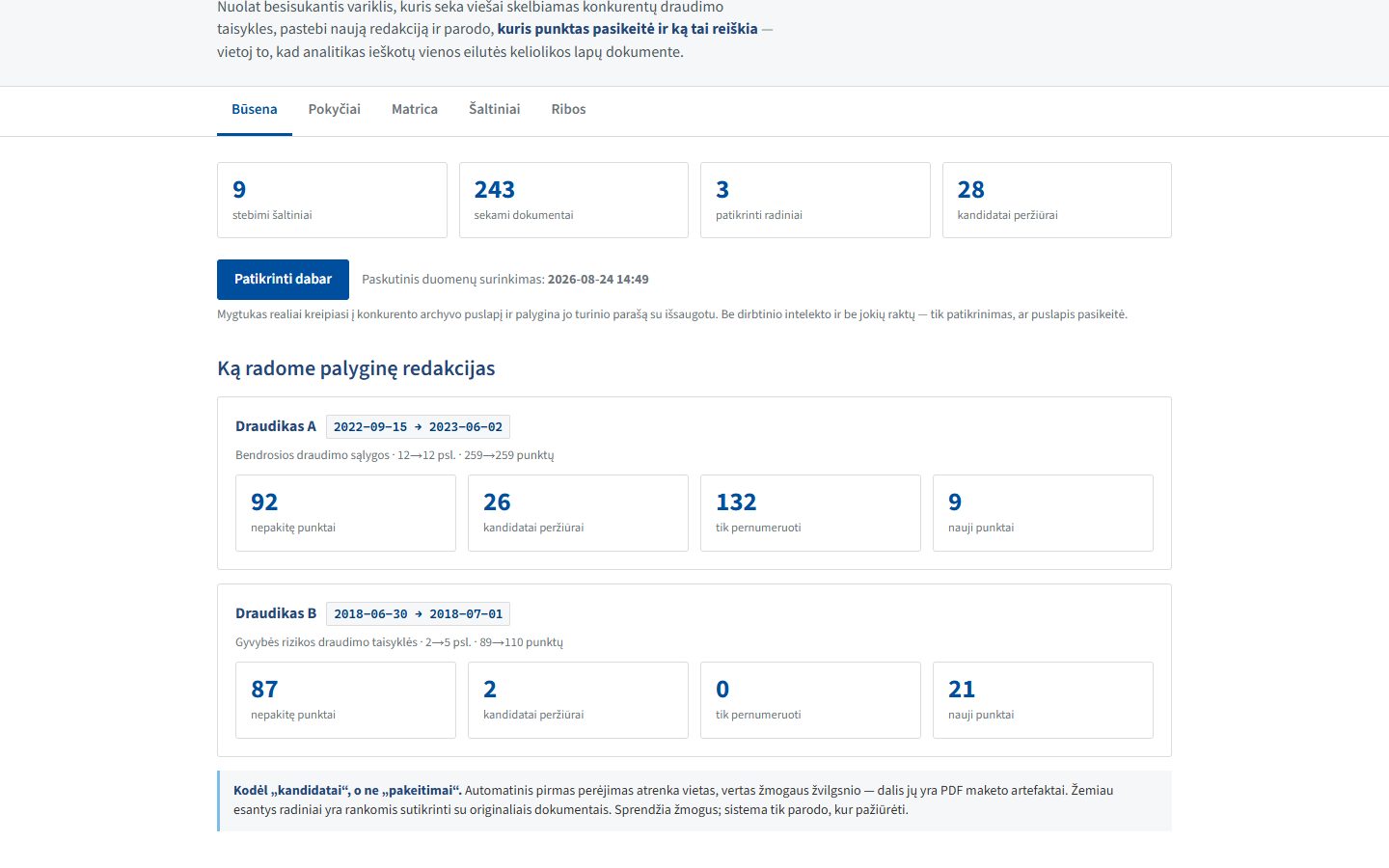
- Watch the sources. The radar follows 9 official public sources: competitors’ terms pages and archives, the regulator’s insurance page, and the insurer’s own archive as a baseline. It keeps track of 243 documents.
- Notice a new edition without AI. A check compares each page’s content signature with the stored one. No model and no keys are needed to know that a page changed.
- Compare clause by clause. A new edition is split into clauses and compared with the previous one. The comparison separates unchanged clauses, clauses that were only renumbered, new clauses, and candidates for review. For one competitor’s general terms that meant 92 unchanged, 132 only renumbered, 9 new and 26 candidates, out of 259 clauses.
- Explain what it means. Verified changes are written up in plain language: what it was, what it became, what it means for customers, and why it matters for the insurer’s own products. One example: a vague duty to report a claim “without delay” became a hard 30-calendar-day deadline, which gives the insurer formal grounds to reduce or refuse a payout.
- Compare exclusions across the market. A matrix shows which exclusion topics (war, nuclear risk, criminal acts, dangerous sports, flying, terrorism, intentional acts and others) appear in each company’s current terms, and in which clause. The empty cells are often the most interesting.
What changes for the product team
| Before | With competitor policy monitoring | |
|---|---|---|
| Knowing a new edition exists | Someone happens to notice | The radar checks the sources and records the date |
| Finding what changed | Read both PDFs side by side | Clause-level comparison, renumbering filtered out |
| Understanding the impact | Analyst’s notes, if time allows | Plain-language explanation with clause and source link |
| Comparing the market | A spreadsheet rebuilt for each question | A living exclusions matrix across competitors |
Where people stay in control
The radar prepares and points; people judge. The first automatic pass deliberately produces “candidates for review”, not “changes”, because part of them are layout artefacts from PDF columns. The findings shown to the product team are checked against the original documents, and each one links to the source so anyone can verify it.
The scope is narrow on purpose. Only official public documents are used, no personal data is processed, and there is no underwriting or pricing: those are high-risk uses under the EU AI Act for life and health insurance. The radar does not give legal opinions.
Where else this works
- Banks and payment companies: competitors’ fee schedules and general terms tracked edition by edition.
- Regulated industries: new regulator guidance compared with the previous version, clause by clause.
- Construction and public procurement: new tender publications and changes to standard contract conditions.
Related use cases: Insurance policy document extraction · Tender document review · EU AI Act for banks. All Market & regulation monitoring use cases · How we deliver this: AI automations
FAQ
Is this web scraping of competitors?
It reads only official public pages where competitors publish their own terms, identifies itself, and processes no personal data.
How does it avoid false alarms from renumbered clauses?
The comparison matches clauses by content, not by number, so a clause that only moved is recognised as renumbered rather than changed.
How often does it check?
As often as the team needs. The frequency, the list of competitors and the format of the result (an email, a report or a dashboard) are set with the product team.
Want to know what changed in your competitors’ terms this quarter? Talk to us