


AI case file analysis matters most on the day a dispute turns serious. The client’s claim letter has gone out, the other side has replied, and the partner asks two questions before lunch: what happened, in what order, and did they ever admit the delay? The answers are spread across a contract, emails, minutes and letters. We built an assistant for a law firm that answers questions like these from the case file alone, ties each statement to a passage in a named document, and lets code confirm that every passage is really there.
The problem: the facts are in the file, but not in one place
Dispute work starts with reading, and the reading repeats as the matter grows:
- One question, many documents. Whether a notice was given on time depends on the contract clause, an internal email, a support ticket and the date of the claim letter. Nobody remembers all four at once.
- Deadline counts hide traps. A ten-business-day term that crosses a public holiday is easy to get wrong by one day, and one day can decide whether a claim was late.
- Unfavourable facts get lost. A read for arguments finds the helpful passages and skips the email where the client apologised for its own delay.
- A summary without a source is not usable. Before anything goes into a letter or a pleading, the lawyer must be able to point to the exact sentence. Chronologies have the same problem, and are rebuilt by hand after each new letter.
What we built
A question-and-answer workspace over one case file:
- The whole file goes to the model as numbered documents. Each keeps its title and date, and the model is told to use nothing outside them.
- The lawyer asks in plain language. Five questions are prepared, from “build the chronology” to “was the defect notice given in time?”, and the lawyer can type their own.
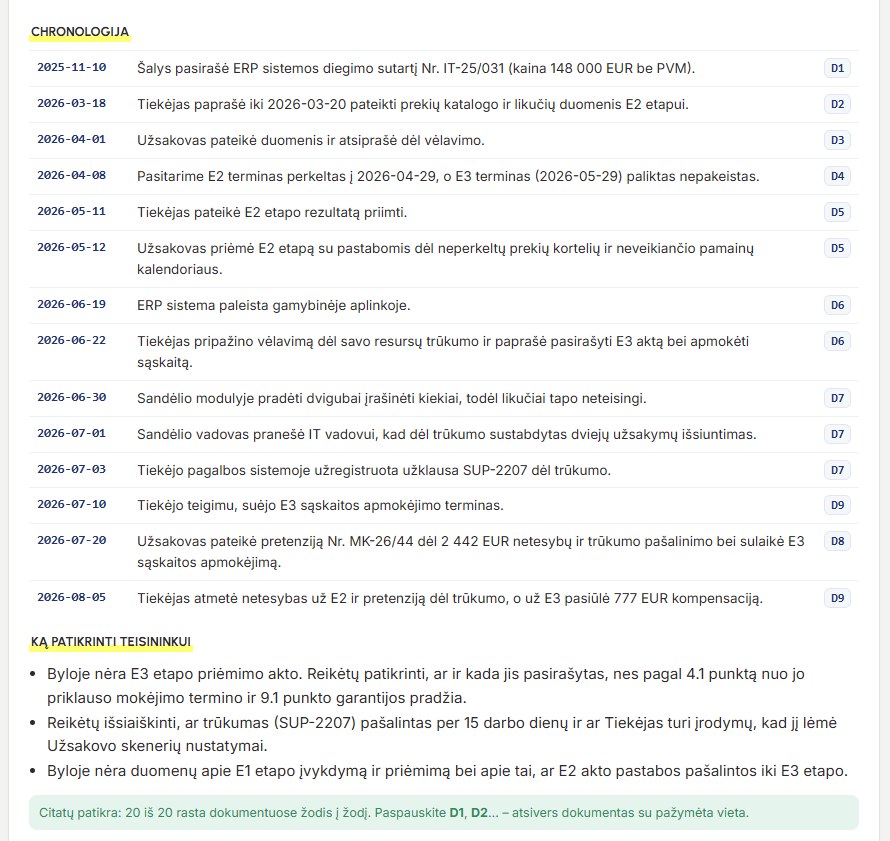
- The model returns a structured answer. A short answer, two to eight supporting statements, each with a document number and a copied passage of 4 to 30 words, dated events for a timeline request, and up to three points to check next.
- Calculations are shown, not just stated. For deadlines and amounts the model writes out its inputs and arithmetic. It counts business days from a list of Lithuanian public holidays for 2026 that it is given, and names the holidays it skipped.
- Code checks every passage and orders the timeline. Each passage is searched for in its cited document, ignoring only case, quotation marks and spacing; a miss is flagged with a question mark. Code, not the model, sorts the chronology by date.
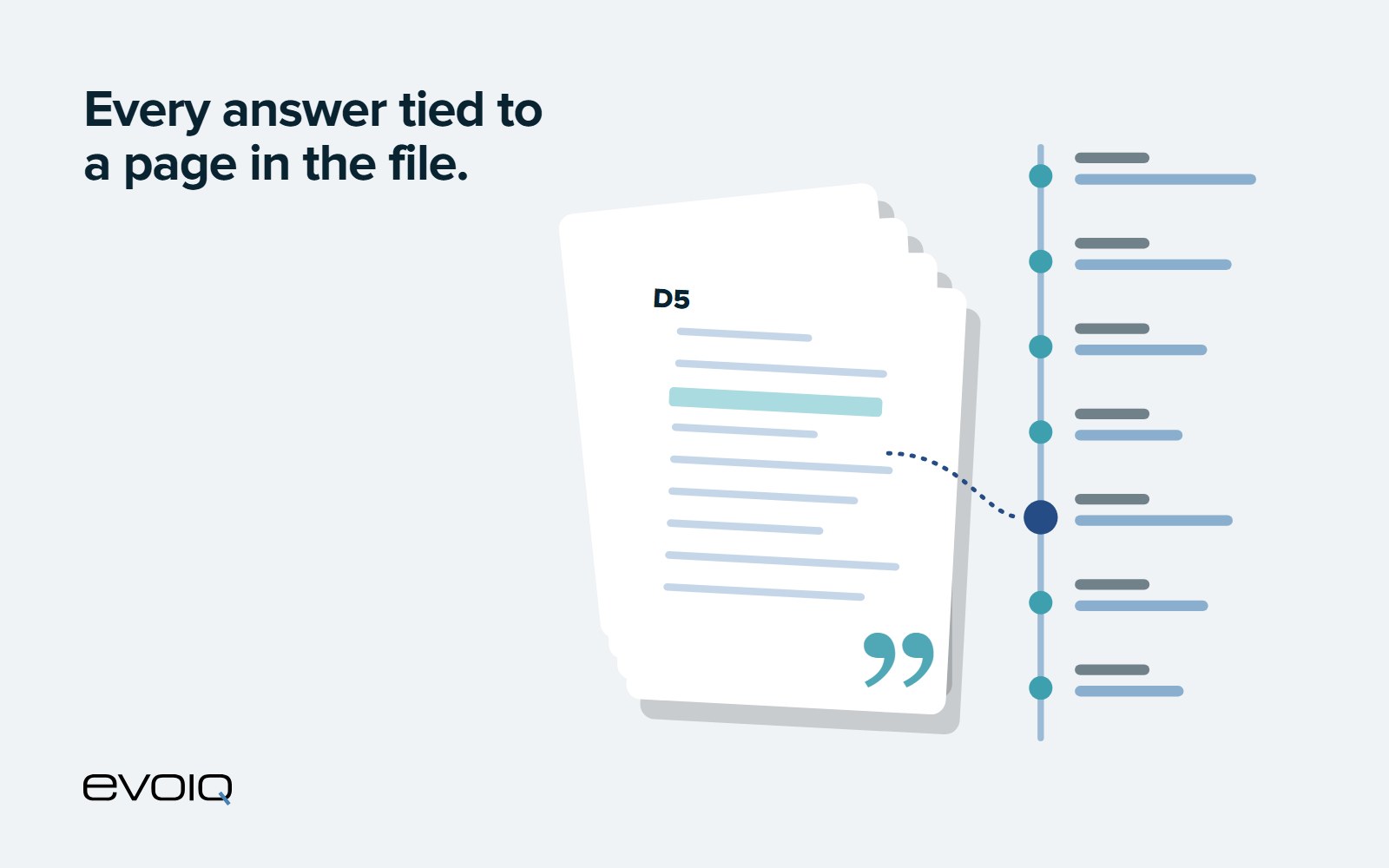
- One click opens the source. Clicking D5 opens the acceptance act with the quoted words highlighted, in context.
We tested it on a fictional dispute over a delayed ERP implementation, written in Lithuanian: 9 documents, with the law firm acting for the customer. Across the five prepared answers the model cited 42 passages, and code found all 42 word for word in the cited documents. The chronology answer drew 14 dated events from all 9 documents. On the notice question it counted the ten-business-day term past the 6 July public holiday; on the penalty question it set out 0.05% of the 148,000 EUR price as 74 EUR per day before multiplying. Asked about the supplier’s insurance, it reported that the file does not say. Prepared answers took between 12 and 42 seconds each.


How many times is the same case file reread before a hearing at your firm? Book a 30-min call and we will look at your process together.
What changes for the litigation team
| Before | With AI case file analysis | |
|---|---|---|
| A factual question | Search folders and reread several documents | A short answer with numbered sources in under a minute |
| Chronology | Rebuilt by hand after each new letter | Dated events with a source each, sorted by code |
| Deadline counts | Counted on a calendar, rarely written down | Inputs, holidays skipped and arithmetic shown in the answer |
| Facts against the client | Found late, sometimes by the other side | Listed next to the favourable ones |
| Gaps in the file | Noticed when a document is missing in court | Named as points to check, for example an unsigned acceptance act |
Where people stay in control
The work is split on purpose. The model reads the file, picks the relevant passages and drafts the answer. Code verifies that each cited passage exists in the document it names and puts the events in date order. The lawyer decides what the facts mean, which arguments to run and what goes into a letter or a claim. It is told to raise facts that hurt the client as well as those that help, and to say when the file has no answer rather than fill the gap.
The limits are real. A verified quote proves that the words are in the document, not that the answer draws the right conclusion from them, so the lawyer still reads the highlighted passage. Day counts and amounts are written out to be checked; they come from the model, not a calendar engine. The test file was small and fictional. A real case folder with scans and hundreds of pages needs its own retrieval step and its own measured results. The firm’s next step would be to run it inside its own document environment, with access limited to the people already working on the matter.
Where else this works
The same pattern of question, cited answer and code check fits any team working from a growing pile of correspondence:
- In-house legal teams: supplier disputes and warranty claims where the record sits in tickets and email.
- Insurance claims handlers: building the sequence of events from a claim file and spotting what is missing.
- Construction and project managers: delay claims where minutes, change requests and letters decide who carries the cost.
Related use cases: AI contract review against a firm’s guidelines · AI meeting minutes and project status · On-premise PII anonymization. All Internal assistants use cases · How we deliver this: Custom AI solutions
FAQ
Can AI answer questions about a case file without making up facts?
It can be built to work only from the documents in the file and to cite a passage for every statement. In our build, code then checks each passage against the cited document, and in the test file all 42 cited passages were found word for word. When the file has no answer, the assistant says so.
Can it build a chronology of a dispute?
Yes. Asked for a chronology, the model returns dated events, each with the document and passage it comes from, and code sorts them by date. In our fictional dispute it produced 14 events from 9 documents, plus open points such as an acceptance act that was missing from the file.
Does it calculate procedural and contractual deadlines?
It shows the count rather than just the result: the start date, each business day, and the public holidays it skipped. That makes the count easy to check, but it is still a draft for the lawyer to confirm, not a final calculation.
Would your associates rather argue the case than rebuild its timeline again? Book a 30-min call or send us a message.
More on this: AI for finance, compliance and legal teams · How we work · All use cases