


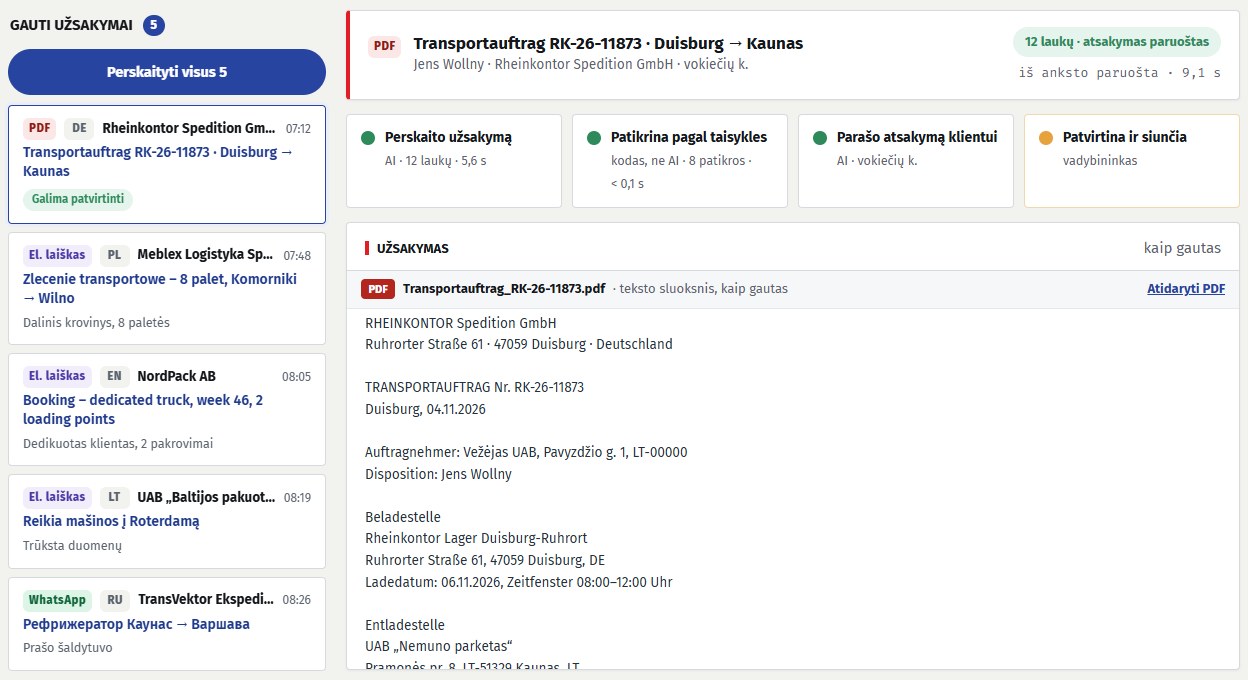
Transport order entry automation starts with a simple fact of road freight: orders do not arrive in one format. A European road freight and trailer rental company receives transport orders as German PDF orders from forwarders, e-mails in Polish, English and Lithuanian, and short WhatsApp messages in Russian. Each one has to be checked, typed into the transport management system (TMS) and answered in the client’s language. We built an assistant that does the reading and the typing, leaves the checks to fixed rules, and leaves the decision to the transport manager.
The problem: every order is a different document in a different language
Typing an order into the TMS is the easy part. The work is everything around it:
- Five languages, three channels. A formal PDF order with conditions in German, a casual e-mail in Lithuanian and a four-line WhatsApp message in Russian all carry the same fields, written very differently.
- The small print matters. Payment terms, waiting-time charges, penalties for late arrival, required documents and a confirmation deadline are buried in the text. Missing one costs money later.
- Not every order fits the fleet. A request for a refrigerated trailer at -18 °C reaches a company that only runs curtain-sider semi-trailers. Someone has to notice before saying yes.
- Contracts and duplicates. A dedicated client may send a price that does not match the framework agreement, or reuse an order number that is already in the TMS.
- Incomplete orders. “Price as usual” with no delivery date means a reply with questions, not a booking.
What we built
An order assistant with a clear split: AI reads and writes, code checks and decides, the transport manager approves and sends.
- Read the order with quotes. AI reads the PDF, e-mail or message in its original language and extracts the client, reference number, each loading and unloading place with date and time window, cargo, trailer requirements, price and conditions. Every field carries a short quote copied word for word from the source, and code confirms that each quote really is in the document. The model copies numbers as written and never calculates; totals across loading places are added up by code.
- Check against the company’s rules. Code runs the same checks every time: required data, dates and transit time from an estimated road distance, capacity of one semi-trailer (24 t, 13.6 loading metres, 33 pallets), trailer type, price per km or price per framework contract, duplicate reference numbers in the TMS, and the payment term against the standard.
- Decide the next step by rule. Each order gets one of four outcomes: can be confirmed, needs clarification, does not fit the fleet, or manual check. Gaps that only the AI noticed do not change the outcome; they become notes for the manager.
- Prepare the TMS record. A structured record with order number, client reference, every stop in route order, cargo, trailer, price and conditions, exportable as JSON or a CSV file that opens in Excel.
- Draft the reply in the client’s language. Code hands the model only the checked facts and the decision, and the model writes a short reply: a confirmation, the exact questions to ask, or a polite refusal with an alternative. Replies not in Lithuanian come with a Lithuanian translation for the manager. The text can be edited and is placed in the mailbox as a draft.
We tested it on 5 fictional orders written the way they arrive: a German PDF order, e-mails in Polish, English and Lithuanian, and a Russian WhatsApp message. Companies, references, contract rates and existing TMS records are all invented. A test script compares each result field by field with a hand-written answer key, including the decision, each check and whether all 43 quotes are found word for word in the source. It also runs 14 rule tests on synthetic orders,. All 145 checks pass. In the test set, code caught a framework contract price that should have been 2,060 EUR instead of 1,980 EUR because of a second loading point, a 45-day payment term against a 30-day standard, a refrigerated request that does not fit the fleet, and an order number already used in the TMS. Reading one order took 7 to 15 seconds.


How many different formats do your transport orders arrive in? Book a 30-min call and we will look at your process together.
What changes for the transport department
| Before | With transport order entry automation | |
|---|---|---|
| Orders in foreign languages | Read and retyped by hand | Fields extracted with a quote from the original |
| Fleet and capacity check | From memory, order by order | Same rule checks on every order |
| Framework contract prices | Looked up separately, if at all | Compared with the contract, difference shown |
| Duplicate order numbers | Found later, if at all | Flagged against existing TMS records |
| Missing data | Noticed when the truck is being planned | Listed as questions in the first reply |
| Reply to the client | Written from scratch | Draft in the client’s language, edited and sent by the manager |
Where people stay in control
Nothing is booked or sent automatically. The transport manager sees the original order next to the extracted fields, the checks and the draft reply, and decides. The order record is only exported for the TMS after the manager confirms, and the reply goes to the mailbox as a draft.
The limits are clear. The test set is small and fictional, so accuracy has to be measured again on real orders before it is relied on. Distances are estimates, not a route planner, so the transit time check is a warning, not a verdict. The rules, contract rates and minimum price per km in the build are examples; in production they come from the company’s own TMS and contracts. Unclear handwriting, poor scans and orders with unusual conditions still need a person.
Where else this works
The same read-check-draft approach fits any team that receives structured requests in unstructured form:
- Freight forwarders: booking requests from shippers in several languages turned into shipment records.
- Warehouses and 3PL: inbound and outbound orders by e-mail checked against capacity and client agreements.
- Distributors and manufacturers: purchase orders from customers checked against price lists and contracts before entry into the ERP.
Related use cases: Freight quote automation · Customs correspondence automation · Supplier invoice reconciliation. All Contracts & documents to data use cases · How we deliver this: AI automation
FAQ
Can AI read transport orders in different languages and formats?
Yes. In our build the same assistant reads a German PDF order, e-mails in Polish, English and Lithuanian, and a Russian WhatsApp message, and extracts the same fields from each, with a quote from the original for every field.
Does the AI decide whether to accept an order?
No. AI only reads the order and writes the reply. Capacity, dates, trailer type, contract price, duplicates and payment terms are checked by code with fixed rules, and the transport manager confirms the order and sends the reply.
How do you know the extracted data is correct?
Every field carries a word-for-word quote that code checks against the source. On our 5 fictional test orders, all 145 checks in the test script passed, including a field-by-field comparison with a hand-written answer key. Accuracy should always be measured again on your own orders.
Do your transport orders still get retyped into the TMS by hand? Book a 30-min call or send us a message.
More on this: AI for real estate, logistics and trade · How we work · All use cases