


A road freight carrier gets quote requests every day from shippers and forwarders all over Europe. They arrive in German, Polish, Italian, French and English, by email and by WhatsApp. Each one has to be read, understood, priced and answered, and the carrier that replies first with a clear price often gets the load. We built a quote assistant that turns each request into a priced, ready-to-send reply in the customer’s own language, so the sales manager checks and sends instead of typing.
The problem: every quote starts with reading
For a carrier running well over a hundred trucks on European lanes, a quote request is never just a question about price. The manager has to pull out the loading and unloading points, dates and time windows, pallet count, weight, whether the cargo is stackable, whether it is dangerous goods (ADR), and what kind of trailer is needed. Only then can the price be worked out: distance, the lane rate, road tolls country by country, ADR and other surcharges.
Three things make this slow:
- Language. A German request with “Komplettladung, Planenauflieger, nicht stapelbar” and a Polish “drobnica, 4 palety” need different vocabulary before any maths starts.
- Messy input. Some requests are complete; others are a single WhatsApp line with a city name and a question mark.
- Consistency. Two managers pricing the same lane on the same day can come up with two different numbers.
What we built
A quote assistant that sits between the inbox and the sales manager. It works in three steps:
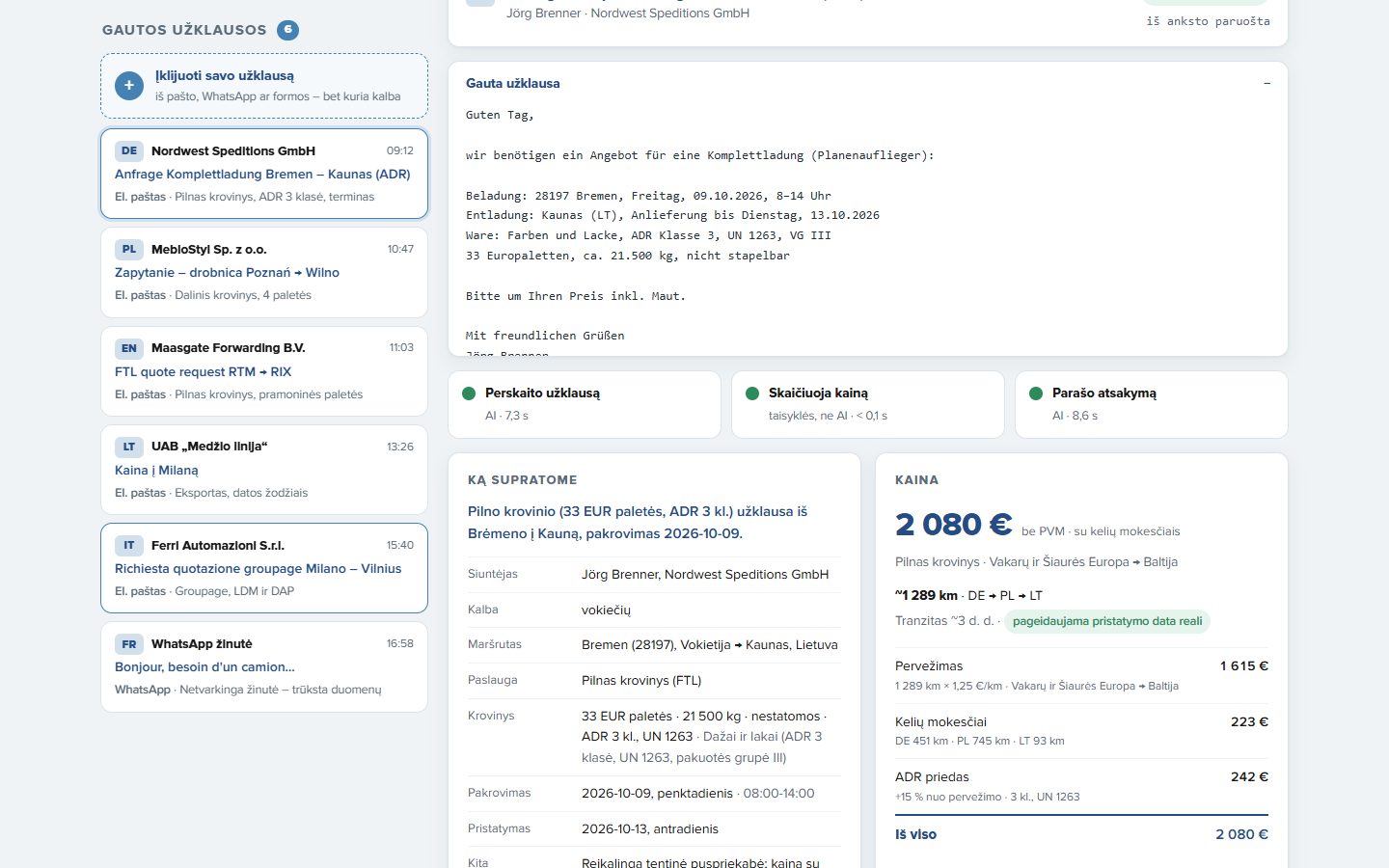
- It reads the request. AI extracts the route, dates, cargo, weight, pallets, ADR class and trailer type from free text in any language, and shows what it understood in a clear table.
- It calculates the price with the company’s own rules. This step is deliberately not AI. Distance by country, the lane rate, road tolls and surcharges are calculated in code from the carrier’s tariffs, so the same request always gets the same price and every line can be traced.
- It writes the reply. AI drafts the answer in the customer’s language, with the price, transit time and conditions. The manager sees a translation into their own language next to it.
When information is missing, the assistant asks instead of guessing. A French WhatsApp message with no date and no weight gets a polite reply asking for exactly those two things.
What changes for the sales team
| Before | With the quote assistant | |
|---|---|---|
| Reading a request | Manually, in the customer’s language | Extracted into a table in seconds |
| Pricing | From memory or a spreadsheet, per manager | Company tariffs applied in code, every line visible |
| Reply | Typed from scratch | Drafted in the customer’s language, ready to check |
| Missing data | Often noticed after the quote went out | Asked for before any price is given |
| Processing time | Depends on who is free | Reading, pricing and drafting in about 20 seconds |
The biggest change is not the 20 seconds. It is that the first answer the customer gets is complete, consistent and in their language, and the manager spends their time on the requests that need a real conversation.
Where people stay in control
The assistant never sends anything by itself. Connected to the mailbox, it picks up new requests and places each reply in the manager’s drafts. The manager checks the price and the wording and presses send.
The price is the company’s, not the model’s. AI reads and writes; the tariff logic stays in plain code that the business owns and can change. If a request falls outside the rules (an unusual lane, an oversized load), it is flagged for a person rather than priced.
Where else this works
The same pattern fits any business where a request in free text has to become a priced offer:
- Wholesale and distribution: a customer email becomes a product selection and a quotation from the catalogue.
- Staffing and IT outsourcing: a project brief becomes a shortlist of matching specialists.
- Manufacturing: a drawing and a message become a first cost estimate.
Related use cases: Automated technical quotation · AI candidate matching · Supplier invoice reconciliation. All Requests to quotes use cases · How we deliver this: AI automations
FAQ
Does the AI decide the price?
No. AI reads the request and writes the reply. The price is calculated in code from the carrier’s own tariffs, tolls and surcharges, so it is repeatable and auditable.
Which languages does it handle?
Any language the requests come in. In this case German, Polish, English, Italian, French and Lithuanian, from email and WhatsApp.
Does it send quotes automatically?
No. Replies are placed in the manager’s mailbox as drafts. A person checks and sends every quote.
Want to see how this would look with your own requests and tariffs? Talk to us