


Trailer fault triage AI starts with a message every rental and transport team knows: a driver writes at night, in their own language, with a photo of a warning light or a torn tyre. Someone has to work out what is wrong, who pays for it under the rental terms, how urgent it is and which workshop is closest. For a European road freight and trailer rental company, we built an assistant that reads the message and the photo, applies the rental terms with a quote, finds the nearest suitable partner workshop and drafts the reply in the driver’s language. A manager approves it before anything is sent.
The problem: every fault message is a small investigation
Answering a fault message well takes several steps:
- Any language, any hour. Drivers write in Russian, Polish, Vietnamese and more, through WhatsApp or Viber, often with a photo instead of a description.
- Who pays depends on the cause. Under the rental terms, a worn tyre or an EBS fault from normal use is the lessor’s cost. A tyre cut by an object or a curtain pierced by a forklift is driver damage, paid by the tenant. An accident goes to insurance.
- The right workshop, not just the nearest one. The company works with about 75 partner workshops across Europe. A few only fit tyres or only repair curtains, and the driver needs one that can fix this fault.
- Deadlines hide in the terms. Body damage and accidents must be reported in writing within 24 hours, and a damage report signed at the loading site decides whether the warehouse can be charged.
What we built
An assistant where AI reads and writes, code decides by rules, and a manager approves:
- AI reads the message and the photo. It detects the language, copies the vehicle codes exactly, finds the location, translates the message and says what the photo shows. It picks one of nine fault categories, from normal wear to tyre damage, body damage, a reefer alarm or an accident.
- AI quotes the rental terms, code checks every quote. The model cites one to three passages from 20 excerpts of the company’s published rental terms. Code checks that each quote exists word for word in the section it names.
- Code makes the decision. The category maps to a fixed verdict: included in the rent, paid by the tenant, insurance, own fleet, or inspection needed. Code sets the final urgency and can only raise the model’s estimate. A brake or EBS error means at least “drive carefully to a service”. A reefer alarm with frozen cargo means at least “urgent”. A cut tyre means do not drive on it, and an accident means stop and wait for help.
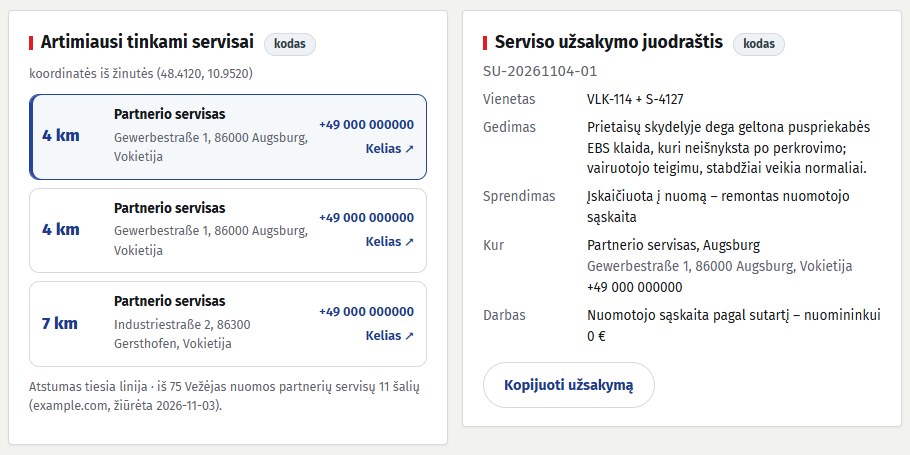
- Code checks the register and finds workshops. The trailer code is looked up in the rental register. Code then lists the three nearest suitable partner workshops: tyre-only workshops are not offered for a curtain, and curtain-only workshops are not offered for a tyre.
- Code drafts the service order. When the tenant pays, a preliminary labour cost is calculated from fixed hours per fault type and the hourly rate, without parts and VAT.
- AI writes the reply, the manager sends it. A second AI step writes the reply in the driver’s language, a translation and an internal note, using only the facts code passed to it. The manager reads, edits and sends.
The same screen keeps a deadline board for inspections, tachograph checks, servicing and reefer hours, with two suggested workshop slots and a reminder in the tenant’s language.
We tested it on four fictional driver messages in Russian, Vietnamese, Lithuanian and Polish, each with a generated photo: an EBS warning, a cut tyre, a curtain pierced by a forklift and a reefer alarm with frozen cargo. Each result is compared with a hand-written answer key for language, vehicle codes, category, urgency, who pays and the first workshop. Every quote is checked against its source, and the workshop phone must appear unchanged in the reply. All 294 automated checks pass. Reading a message and photo took 15 to 20 seconds, the code step less than 0.1 seconds, and writing the reply another 15 to 19 seconds.


Do your managers spend their mornings working out who pays for last night’s breakdowns? Book a 30-min call and we will look at your process together.
What changes for the rental and dispatch teams
| Before | With trailer fault triage AI | |
|---|---|---|
| Message in a foreign language | Translated by hand or by a colleague | Translated in full, with what the photo shows |
| Who pays | Decided from memory of the terms | Fixed rule per fault type, with a checked quote from the terms |
| Urgency | Depends on who reads the message | Safety rules for brakes, tyres, frozen cargo and accidents |
| Which workshop | Searched in a list of about 75 | Three nearest that can do this repair, with distance and phone |
| Reporting deadlines | Easy to miss at night | 24-hour notice and damage report added to the steps |
| Reply to the driver | Written from scratch | Drafted in the driver’s language, approved by a manager |
Where people stay in control
The assistant sends nothing on its own: every reply is a draft a manager approves. The verdict on who pays is a first assessment from the message and the photo. The signed contract prevails, and disputed cases are decided by people, with the workshop’s diagnostic report.
The limits are clear. A photo can be misleading, so when the message and the photo do not match, the assistant picks “inspection needed” and suggests questions to ask the driver. Cost figures are preliminary labour estimates without parts. If the location cannot be found, no workshop is suggested and the reply tells the driver that the team will send an address. With four fictional test messages, accuracy has to be measured again on your drivers’ real messages.
Where else this works
The same pattern fits other teams that handle fault or damage reports:
- Truck and van leasing: breakdown messages checked against lease terms, with the nearest approved workshop.
- Equipment rental: damage reports from construction sites sorted into wear and tenant damage before the invoice.
- Fleet management: driver reports turned into service orders with urgency set by safety rules.
Related use cases: Freight quote automation · Customs correspondence automation · AI voice agent for service booking. All Internal assistants use cases · How we deliver this: Custom AI solutions
FAQ
Can AI decide who pays for a trailer repair under the rental terms?
AI reads the message and the photo and picks the fault type. Code then applies a fixed rule for that type, and the model has to quote the rental terms word for word, which code checks. A manager approves the result, and the signed contract prevails.
Which languages can drivers write in?
Any language the model reads. We tested Russian, Vietnamese, Lithuanian and Polish messages. The reply goes back in the driver’s language, with a translation for the manager.
How does it choose the workshop?
Code calculates the distance from the driver’s location to every partner workshop and shows the three nearest that can do this kind of repair. Tyre-only and curtain-only workshops are filtered by fault type.
Do your drivers’ fault messages still wait for someone to translate and check the terms? Book a 30-min call or send us a message.
More on this: AI for real estate, logistics and trade · How we work · All use cases