


An AI voice agent for service booking picks up the calls a service network used to lose after closing time. We built a Lithuanian-speaking voice assistant for a vehicle glass repair and replacement network: when the contact centre is closed, it answers, finds out what happened, works out whether the job is a repair or a replacement, collects everything the branch needs and leaves a complete, structured request for the morning.
The problem: the evening call goes to voicemail
A stone hits a windscreen on the motorway at 21:40. The driver calls. The contact centre works business hours and a short Saturday, so the call ends in voicemail or not at all. By the morning the customer may have booked elsewhere.
Even during working hours, one call carries a lot of decisions. Where on the glass is the damage and how big is it? Is it in the driver’s field of view? Does the car have a front camera for driver-assistance systems (ADAS) that must be recalibrated after a replacement? Which insurer covers the car, and who registers the claim: the service company or the customer? Which branch and what time suits? An experienced agent handles this in one call. A voicemail handles none of it.
What we built
A voice assistant that holds a real conversation, not a phone menu:
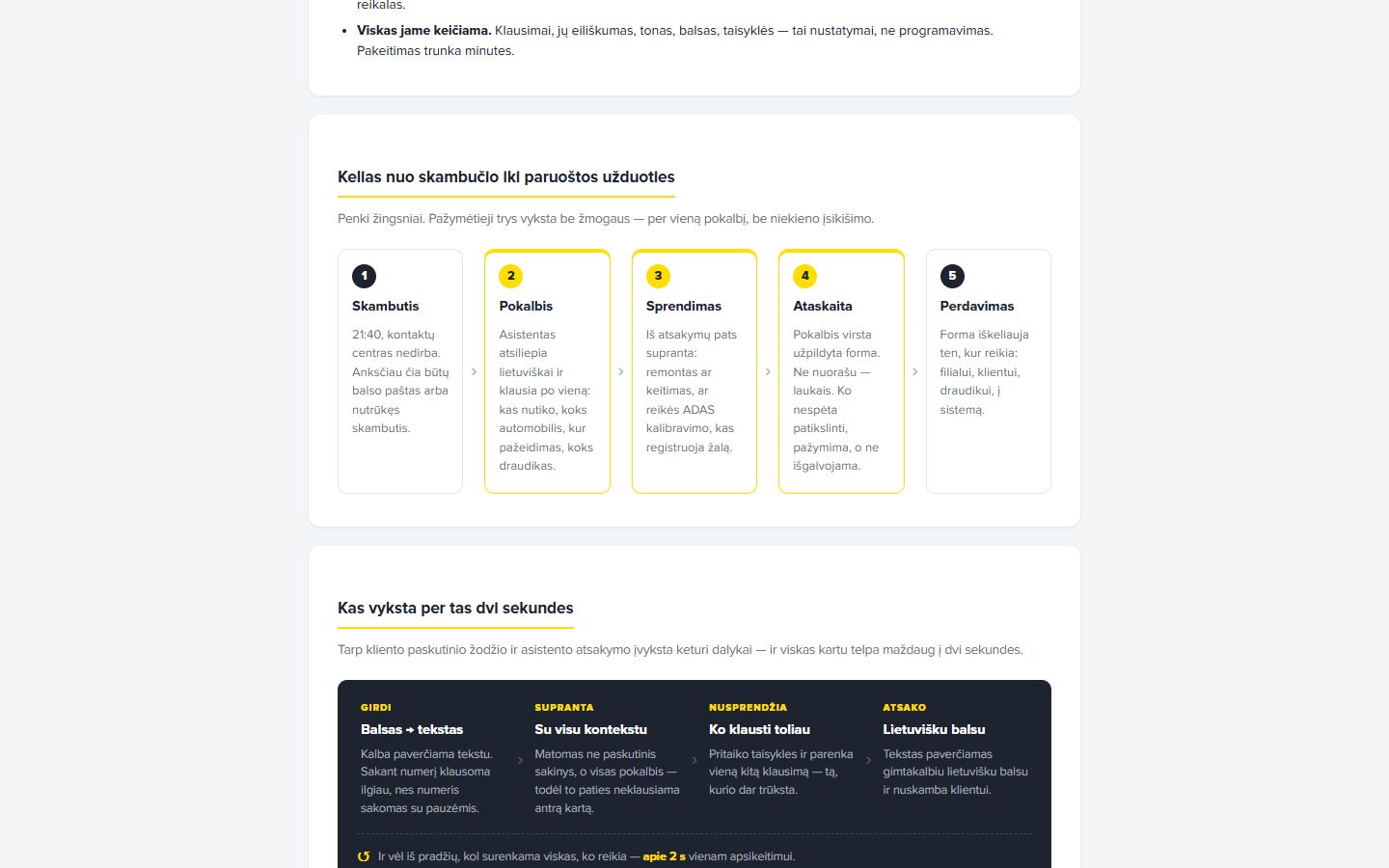
- It answers in Lithuanian. Speech becomes text; when the customer dictates a phone number, it listens longer, because numbers are said with pauses.
- It keeps the whole conversation in view. It does not ask the same thing twice, and asks one question at a time, only for what is still missing.
- It applies the company’s rules. Damage smaller than about 2 cm and outside the driver’s field of view is usually repairable; a crack or damage in front of the driver means replacement. ADAS calibration is needed when the glass is replaced, not when it is repaired. Depending on the insurer, the company registers the claim itself or the customer does.
- It uses the right words. The trade vocabulary for chips, cracks and breaks, in natural Lithuanian, with a native Lithuanian voice.
- It ends with a structured report, not a transcript. Damage location and size, make, model and year, ADAS, insurer and cover, city and preferred time, name and phone. Anything it could not confirm is marked, never invented.
Each exchange takes about two seconds from the customer’s last word to the assistant’s reply: listen, understand, decide what to ask, answer.
What changes for the service team
| Before | With the AI voice agent | |
|---|---|---|
| Calls after closing time | Voicemail or a missed call | Answered and qualified |
| Repair or replacement | Decided on the next call | Suggested from the customer’s answers |
| ADAS and insurer questions | Often asked twice | Collected once, in the right order |
| What the branch receives | A phone number to call back | A complete, structured request |
| Next steps | Typed by hand in the morning | Confirmation to the customer, task for the branch, note for the insurer |
The point is not to replace the contact centre. It is to make sure the morning starts with a list of jobs ready to confirm rather than a list of numbers to call back.
Where people stay in control
The assistant does not decide for the business. Its job ends when the information is collected and structured; the team decides what happens next. It works in front of the existing booking platform and passes it a tidy request, so it can go live without waiting for integrations.
Everything is configuration rather than programming: the questions and their order, the tone, the voice (thirty native Lithuanian voices to choose from), the repair rules, the branch list, the opening hours, the channels, and when to hand over to a person. A change takes minutes. One honest limit: until the assistant is connected to the booking system, the times it offers must come from a calendar the team maintains.
Where else this works
Any business that takes bookings by phone and loses the calls that come outside office hours:
- Car service and tyre centres: booking, reminders and routing to the nearest site.
- Clinics and diagnostic centres: appointment requests collected with the details the front desk needs.
- Property and facility management: after-hours fault reports turned into structured work orders.
Related use cases: Freight quote automation · AI meeting minutes and project status · Product catalogue AI assistant. All Voice & customer service use cases · How we deliver this: AI automations
FAQ
Does the caller know they are talking to an AI?
Yes. The assistant introduces itself as a digital assistant at the start of the call.
Which language does it speak?
Lithuanian, in short sentences with the correct trade terms, using a native Lithuanian voice. Other languages can be added the same way.
Do we have to change our booking system?
No. The assistant works in front of it and hands over a structured request. Writing bookings straight into the system is an optional next step.
Want to hear how an after-hours call would sound in your business? Talk to us