



Automated technical quotation changes the slowest step in a technical sales team: turning a customer’s email into a product selection, quantities and a price. We built a quotation assistant for a lighting solutions company that reads a request written in plain language, picks suitable luminaires from its own catalogue of more than 2,000 models, calculates how many are needed and prepares a draft cost estimate with the energy savings, so the specialist starts from a finished draft instead of a blank spreadsheet.
The problem: every offer is assembled by hand
The company designs and supplies LED lighting for offices, retail, warehouses, industry and outdoor areas. Its catalogue is wide and technical: efficacy, colour rendering, ingress and impact protection, beam angles, control protocols such as DALI, warranty terms. There is no configurator. Every request arrives by phone or email, often with an electrical project attached as a PDF, and every offer is put together by a person.
For a team of around fifteen people that is a hard limit. The time spent reading requirements, searching the catalogue and doing the same lighting arithmetic again decides how many projects the company can quote in a month. The most time goes into pulling the key requirements out of long technical documents, where most of the nuance sits.
What we built
A quotation assistant that goes from request to draft offer in one pass:
- It reads the request. A language model extracts the requirements from free text: area, mounting height, required illuminance, protection class, colour rendering, control system, warranty, the existing installation to be replaced.
- It shows what it understood. Every extracted requirement appears on screen, and anything missing is marked, so the specialist can correct it before any calculation.
- It selects products from the real catalogue. Only models that meet every stated requirement are shortlisted, and the options are ranked by total installed power.
- It calculates quantities with a standard method. The number of luminaires comes from the lumen method, N = (E × A) / (Φ × UF × MF). The assumptions (utilisation and maintenance factors, room index) are shown, so an engineer can challenge them.
- It drafts the estimate and the savings. A cost estimate for the chosen option, plus energy use before and after and the payback period, using the company’s own prices and installation rates.
The language model only reads the email. Product selection, quantities and prices are calculated in code and can be checked line by line. When a request is incomplete, the assistant refuses to calculate and lists what it needs instead.
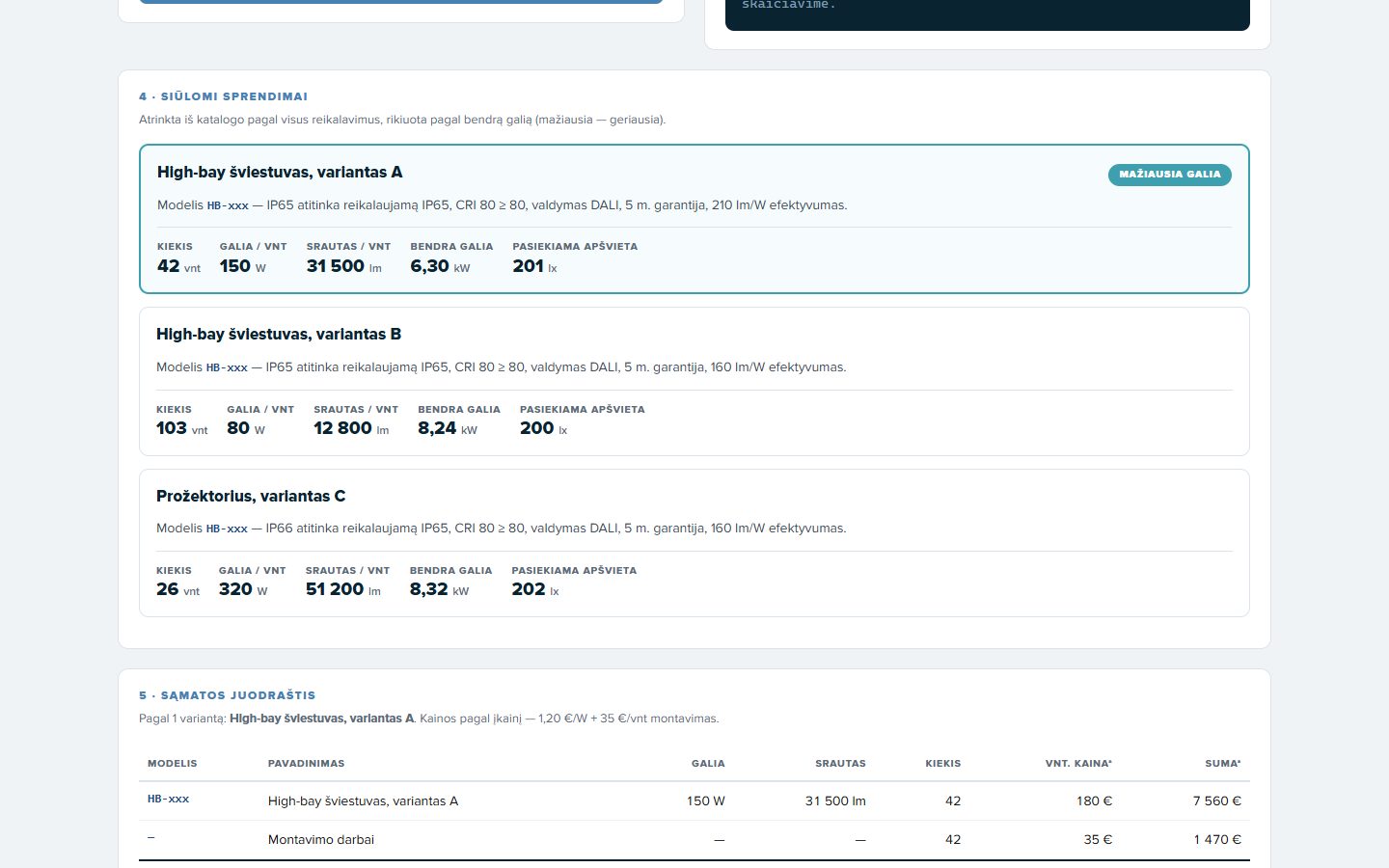
In one warehouse request (4,000 m², 10 m ceiling, 200 lx, IP65, DALI, 180 existing 400 W fittings), the selected option brings the installed load from 72 kW to 6.3 kW, and the payback is calculated from the customer’s own electricity price and operating hours.
What changes for the team
| Before | With the quotation assistant | |
|---|---|---|
| Reading the request | Manually, often from a long PDF | Requirements extracted and shown for review |
| Finding products | Searching the catalogue by memory | Only models that meet every requirement, ranked |
| Quantities | Recalculated by hand for each option | Lumen method with visible assumptions |
| Estimate and savings | Built in a spreadsheet | Drafted with the company’s prices and rates |
| Incomplete requests | Guesses, or a delayed reply | A clear list of what to ask the customer |
The specialist’s job shifts from assembling the offer to judging it: is this the right option for the customer, and what should the offer emphasise.
Where people stay in control
The assistant prepares a draft; a specialist decides what goes to the customer. The selection logic is open, so the team can see why a model was chosen when other catalogue items would also fit, and adjust the rules. Catalogues and supplier price lists are updated when the team decides, not on a fixed schedule, because manufacturers change them at different times.
One limit is worth saying plainly: this is a fast first estimate, not a lighting design. For projects that need a full photometric calculation, the engineer still runs it in dedicated lighting software.
Where else this works
Any business that answers technical requests from a catalogue can use the same pattern:
- Freight and logistics: a transport request in any language becomes a priced reply.
- Building products and HVAC: a specification becomes a product list and a quotation.
- IT staffing: a project brief becomes a shortlist of matching specialists.
Related use cases: Freight quote automation · AI candidate matching · Product catalogue AI assistant. All Requests to quotes use cases · How we deliver this: AI automations
FAQ
Does the AI set the price?
No. AI reads the customer’s request. Product selection, quantities and prices are calculated in code from the company’s catalogue, price list and installation rates.
What happens when the request is missing information?
The assistant does not guess. It stops before calculating and lists the missing details, such as illuminance level or mounting height, so the specialist can ask the customer.
Can it read project documents, not only emails?
Yes. Requirements can come from the email text and from attached technical project files, which is where most of the reading time goes today.
Want to see your own catalogue and a real customer request turned into a draft offer? Talk to us